

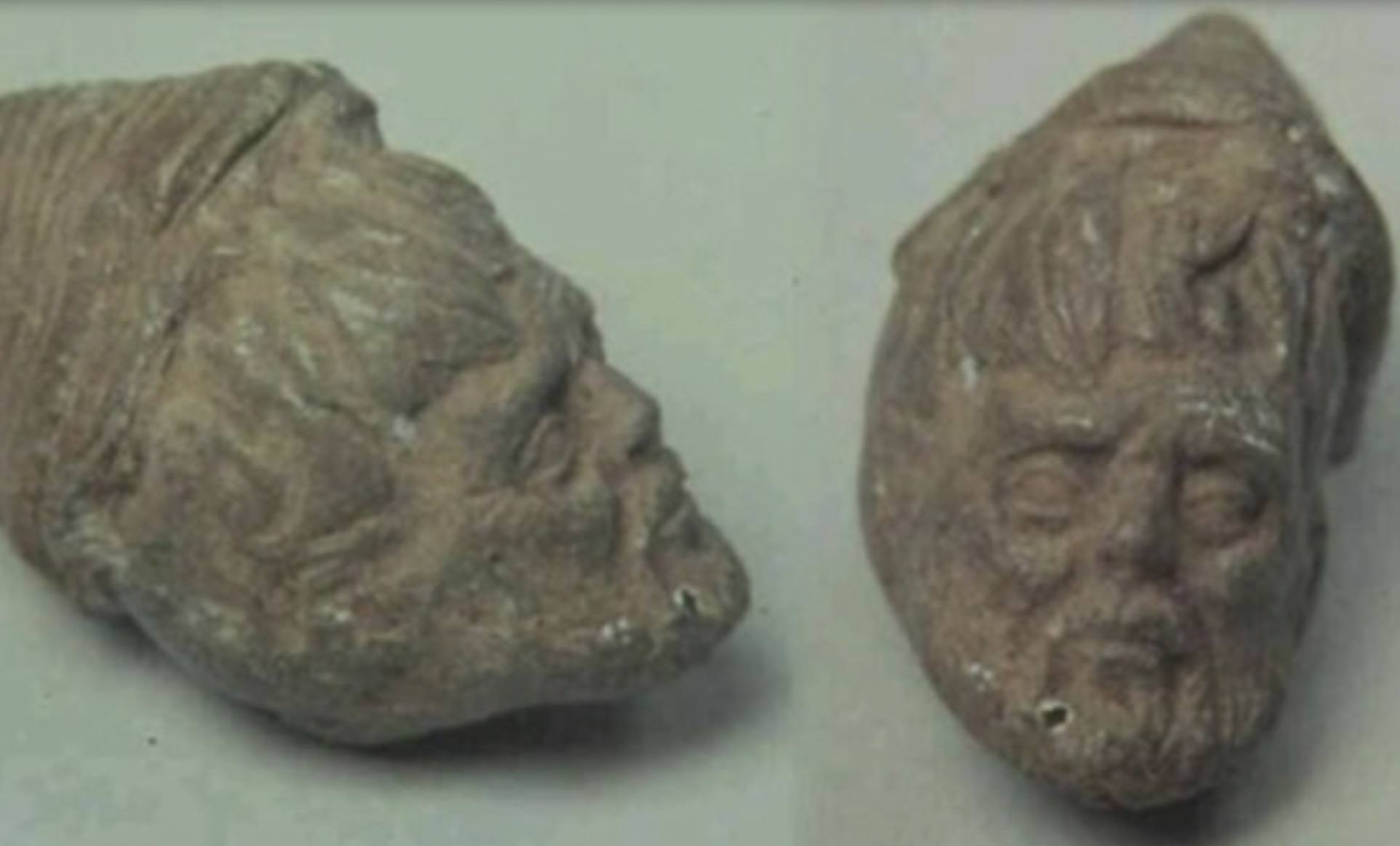
A tiny terracotta head dug up in Mexico is once again sending history fans into a frenzy — because if it’s real and truly ancient, it doesn’t just tweak the Columbus timeline. It torches it.
The object is known as the Tecaxic-Calixtlahuaca Head, and it’s exactly what it sounds like: a small clay sculpture of a bearded man with features that look far more “ancient Mediterranean” than Mesoamerican. It was reportedly discovered in 1933 inside a pre-Hispanic burial in central Mexico — and here’s the part that keeps the argument alive: archaeologists said it came from a sealed tomb beneath multiple intact floor layers, suggesting the grave hadn’t been disturbed after it was closed.
In other words, if the excavation notes are accurate, the head wasn’t casually dropped in there later. It was placed with the burial — and that burial has been dated to the late 1400s, just years before Hernán Cortés arrived.
So how does a suspiciously Roman-looking artifact end up in a Mexican tomb before Europeans “officially” showed up?
That’s the question that has split experts for decades.
The “It’s Roman” camp points to the style. In the 1960s, German archaeologist Bernard Andreae argued the piece was “without any doubt Roman,” linking it to the Severan period — roughly around 200 AD — based on the hairstyle, beard shape, and craftsmanship associated with that era’s portrait styles.
And it didn’t stop at style arguments. Thermoluminescence testing, which estimates the age of ceramics by measuring stored energy released as light when heated, has been cited as supporting the artifact’s antiquity — suggesting it predates European contact with the Americas.
That combination — Roman-looking design plus scientific dating plus a supposedly sealed burial — is why some people leap to the headline-grabbing conclusion: Romans reached the Americas more than 1,000 years before Columbus.
But the skeptics have a blunt response: show the rest of the evidence.
Because if Romans crossed the Atlantic, critics argue, you’d expect more than one lonely artifact. No Roman ships. No settlements. No tools. No trail of trade goods. Nothing that clearly proves a Roman presence in the New World.
So what are the alternative explanations?
One major possibility: it arrived later than people think.
Even if the head was made in Roman times, skeptics say it could have been transported across oceans during the early period of European exploration, when objects circulated in messy, unpredictable ways. A “Roman-era” piece could have ended up in Spanish hands and later been traded, lost, or gifted — and eventually placed in a burial site after contact began.
Then there’s the darker suggestion: a hoax or accidental contamination.
Some researchers have pointed to gaps and uncertainties in the documentation from the 1933 excavation led by José García Payón, including accounts that he wasn’t always present — leaving room, at least in theory, for the object to have been planted or mishandled.
Supporters of the artifact’s authenticity push back hard on that, arguing the context is the entire point: a sealed burial under intact layers is exactly the kind of setting that should rule out later meddling — if the reporting was accurate.
And that’s where the debate gets sticky: archaeology lives and dies by context. If the context is solid, this is a true mystery. If the context is flawed, it could be a fascinating but explainable out-of-place object.
There’s also a middle-ground theory that’s getting renewed attention: accidental contact.
Some researchers argue you don’t need a full Roman “expedition” to explain a Roman artifact in the Americas. Ancient Mediterranean ships — Roman, Phoenician, Berber, or otherwise — could theoretically be swept off course and carried by major Atlantic currents. Under that scenario, a drifting vessel could reach the Americas, its cargo recovered, and objects traded inland over time until they lose any obvious link to their origin.
Ocean currents like the Canary Current and the North Equatorial Current can, under the right conditions, move floating debris across long distances. But critics counter that “possible” is not the same as “proven,” and one artifact still isn’t a smoking gun.
What makes this story especially irresistible is that archaeology has been humbled before.
For generations, the idea that anyone reached the Americas before Columbus was treated like fringe fantasy — until Norse settlement evidence at L’Anse aux Meadows confirmed transatlantic contact centuries earlier.
That history lesson is why the Tecaxic-Calixtlahuaca Head won’t die as a headline. It’s an anomaly. And anomalies either turn into breakthroughs… or cautionary tales.
For now, most mainstream archaeologists remain careful: interesting, weird, worth studying — but not enough to rewrite the textbooks.
Still, one thing is clear: if another unmistakably Roman artifact ever turns up in a properly documented, indisputable pre-contact layer, the “Romans got here first” argument won’t sound like internet bait anymore.
It’ll sound like history class catching up.
A Roman sword was found in Michigan copper mine years ago