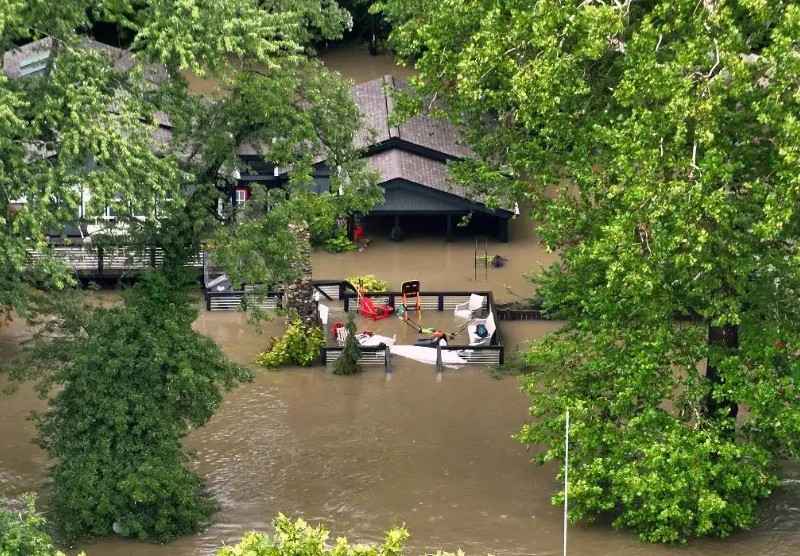
At least six people are dead after days of brutal storms hammered Indiana, unleashing torrential rain, widespread flooding, power outages and dozens of emergency rescues.
Some of the worst damage was reported in Hamilton County, where officials said floodwaters were finally beginning to recede Sunday after what they described as a historic flooding disaster.
One of the biggest concerns was the White River, which surged to levels not seen in more than a century.
On Saturday, the river reached 24.6 feet, smashing a record that had stood since 1913.
“I must admit, it is a good morning. It’s not raining, and the water is receding,” Hamilton County Board of Commissioners President Christine Altman said Sunday.
Officials said the White River had fallen to about 21 feet by Sunday morning, a significant improvement, but warned that the danger was far from over.
“The roads are becoming drier and clearer, but that does not mean that the hazard has stopped,” Michael Hubbs, director of administration for the Hamilton County Board of Commissioners, said.
At least one bridge crossing the White River in Hamilton County was damaged during the storm.
The flooding also devastated neighborhoods and businesses.
In Carmel, at least 215 properties were affected and around 40 residents were forced from their homes, Mayor Sue Finkam said.
Nearby Noblesville was also hit hard.
Mayor Chris Jensen said approximately 170 residents were evacuated over a 72-hour period, with many fleeing alongside their pets.
About 552 residential units in Noblesville were impacted by the historic flooding.
Hamilton County remained under a flood watch Sunday as officials continued monitoring the river and assessing damage.
The storms have also turned deadly.
Officials confirmed at least five deaths during a Saturday briefing, while the Indiana Department of Homeland Security later confirmed a sixth person had died since severe weather began pounding the state on Aug. 11.
Among the victims was a 4-year-old boy in Jennings County who was killed Tuesday when a tree crashed onto his home during severe weather.
A 19-year-old man and a 58-year-old woman in Delaware County were also among those killed, state officials said.
Emergency crews carried out dozens of water rescues as streets and neighborhoods filled with rapidly rising water.
The Indianapolis Fire Department alone said crews performed 50 water rescues over several hours, evacuating 91 people and 45 pets.
Indianapolis Mayor Joe Hogsett said the city was experiencing flooding unlike anything it had seen in decades.
“The city of Indianapolis is currently facing a flooding event that we have not seen in over 30 years,” Hogsett said Saturday.
He warned that conditions were changing rapidly as additional rain continued threatening the region.
Noblesville also shattered its previous flood record.
“The last 48 hours have been unprecedented in this community,” Jensen said.
The White River’s old record was 23.8 feet, set in 1913. This time, the river climbed to 24.6 feet.
The storms also knocked out power to huge portions of the state.
At one point Saturday, at least 150,000 customers were without electricity, according to Indiana Department of Homeland Security Executive Director Jonathan Whitham.
Gov. Mike Braun declared a state of emergency Thursday as the crisis intensified.
Braun later said he spoke with President Donald Trump about the severe storms and historic flooding and that the president agreed to provide federal assistance.
Even as water began dropping in parts of Indiana Sunday, the broader Midwest remained under threat.
Flood watches stretched from Peoria, Illinois, through Indianapolis and east toward Charleston, West Virginia.
Parts of West Virginia faced a moderate flash-flood threat, including Beckley, Elkins, Clarksburg and Morgantown, while Pittsburgh was also expected to see additional rounds of rain.
With soil across the region already saturated, forecasters warned that even more rainfall could trigger dangerous and potentially life-threatening flash flooding.
For communities already dealing with flooded homes, damaged roads and deadly destruction, the threat was not over yet.