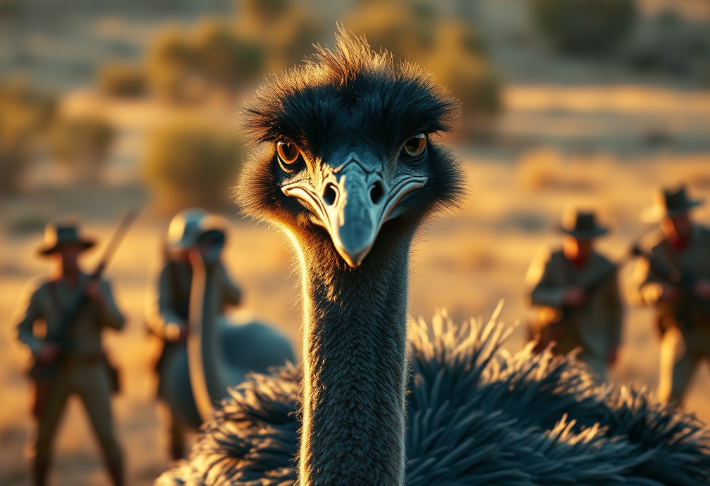
In 1932, as the world grappled with the Great Depression, Australia found itself embroiled in an unexpected and absurd conflict: The Great Emu War. While “war” might suggest an organized military conflict, this “war” was anything but typical.
It was a battle between the Australian government and a population of rogue emus—large, flightless birds—roaming across Western Australia’s farming lands. With the might of machine guns, military tactics, and unrelenting emu determination, the event has since become one of history’s strangest military operations, where the birds, seemingly invincible, came out on top.
The Setting: Western Australia’s Post-War Woes
Following World War I, the Australian government incentivized war veterans to settle on farmland in Western Australia. They hoped that ex-soldiers could help expand agricultural production and increase the country’s crop yields. However, by the early 1930s, these veteran farmers faced devastating economic hardship. The Great Depression had weakened crop prices, and farmers were barely getting by. If that wasn’t bad enough, a new threat loomed on the horizon—an enemy with long legs, a powerful stride, and an insatiable appetite for crops: the emus.
Each year, emus migrate inland after breeding season, searching for food. In 1932, an unprecedented flock of 20,000 emus descended upon the farmlands of Western Australia. This massive population devastated wheat crops, uprooted fencing, and generally wreaked havoc across the struggling farms. Desperate for a solution, farmers sought government assistance. But instead of deploying agricultural remedies or protective fencing, the government opted for a more radical approach: they sent in soldiers.
Mobilizing the Military: The Emu “War” Begins
In November 1932, the Australian government, led by Minister of Defense Sir George Pearce, decided to take a militaristic approach to the emu problem. They dispatched Major G.P.W. Meredith of the Seventh Heavy Battery of the Royal Australian Artillery, along with two Lewis machine guns and 10,000 rounds of ammunition. The mission was simple: wipe out the emus.
The operation commenced in the Campion district on November 2. Expectations were high, as officials anticipated a quick and effective campaign that would eliminate thousands of birds. Instead, the mission quickly unraveled. Emus proved to be surprisingly elusive. With their quick reflexes and surprising speed, they dispersed into smaller groups, making it difficult for soldiers to target large numbers at once.
A Comedic Disaster: The Battle Plays Out
The first encounter between the soldiers and the emus did not go as planned. As the soldiers opened fire on a group of about fifty emus, the birds scattered in every direction, making it nearly impossible to take them down with concentrated gunfire. Only a handful of emus were killed in this first engagement. Frustrated but undeterred, Meredith and his team regrouped and tried again.
For several days, they attempted to ambush emus along roads and near water sources, but the birds proved unexpectedly resilient and seemed to outwit the soldiers at every turn. The emus moved erratically, often in groups too small to be effectively targeted by the heavy machine guns, which were built for concentrated fire, not picking off fast-moving targets in open fields.
In one particularly disastrous attempt, soldiers mounted a machine gun on a truck, hoping to chase down the birds. However, the terrain was rough, and the truck quickly lost control, crashing before any emus could be targeted. The truck-mounted machine gun experiment was abandoned, leaving soldiers no closer to victory than when they had started.
The Emus Prevail: An Embarrassing Retreat
After nearly a month of skirmishes, the emu “war” was called off. In the end, the soldiers had used up much of their ammunition, yet only managed to kill around 1,000 emus—far fewer than the anticipated mass culling. Meanwhile, emus continued to roam the farmland largely unscathed, having developed a reputation among soldiers as “feathered tanks” due to their surprising resilience and agility.
Major Meredith later lamented the campaign, noting, “If we had a military division with the bullet-carrying capacity of these birds, it would face any army in the world. They can face machine guns with the invulnerability of tanks.” The press got wind of the story, and soon news of Australia’s failed campaign against birds spread around the world, leading to ridicule and disbelief.
Aftermath: The Legacy of the Great Emu War
Though the Great Emu War was an undeniable failure, Australia didn’t entirely give up on curbing the emu problem. The government eventually provided subsidies for farmers to build better fences, and over time, populations of emus were controlled more effectively through these preventative measures. The story of the Great Emu War became an infamous and humorous chapter in Australian history—a bizarre reminder of how unconventional approaches can backfire spectacularly.
For Australia, this surreal conflict remains a quirky piece of folklore. It’s a tale of unintended consequences and the unpredictable nature of wildlife, where nature itself got the last laugh. To this day, the Great Emu War serves as a peculiar reminder that, when it comes to large, feathered “invaders,” brute force doesn’t always carry the day.
A Footnote in History: Emus as National Icons
Today, emus remain a protected species and hold a place on Australia’s coat of arms alongside the kangaroo. Ironically, these resilient birds are now celebrated as national symbols, revered for their strength and adaptability. While the Great Emu War might have ended in a loss for the Australian government, it solidified the emu’s place as a creature of legend and an enduring symbol of Australia’s natural wildness and unique history.
The Great Emu War is one of history’s quirkiest and most humbling military operations, a reminder of humanity’s often futile attempts to control nature. For the people of Western Australia, it was a hard-fought battle; for the emus, a display of survival against all odds. As far as oddball historical moments go, this one stands out as both a cautionary tale and a curious badge of pride in the annals of Australian and world history.