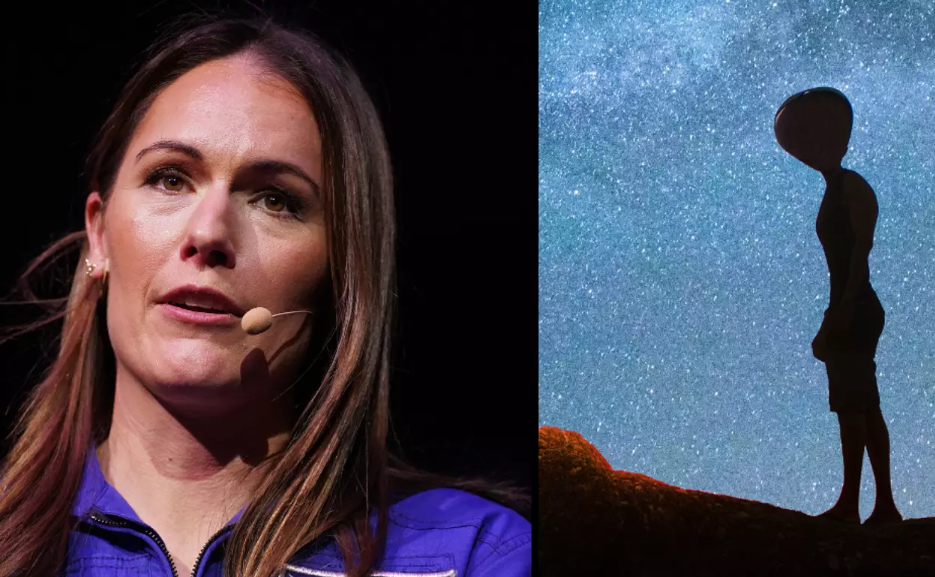
The universe may teem with alien life, but a colossal challenge prevents us from connecting with it, according to Katherine Bennell-Pegg, Australia’s first female astronaut and Director of Space Technology at the Australian Space Agency.
Speaking at Sydney’s South by Southwest (SXSW) conference, Bennell-Pegg boldly declared, “There are definitely aliens out there. I don’t think they walk among us, even if it feels like that sometimes.”
Her insights come as debates over extraterrestrial life gain momentum. Just last month, NASA suggested that Mars’ underground icy layers could harbor microbial life. Meanwhile, former U.S. President Donald Trump vowed to declassify UFO files during a chat with Joe Rogan, reigniting public fascination with what lies beyond.
But Bennell-Pegg’s focus is on the sheer scale of the task at hand. “The universe contains 100 to 200 sextillion stars—about as many as the grains of sand on Earth’s beaches. The ingredients for life—molecules and elements—are the most abundant materials in the universe,” she explained.
Despite this, our efforts to search for life are barely scratching the surface. Over the past six years, space telescopes have identified nearly 6,000 exoplanets, many within the “habitable zone” where conditions could support life. Yet the question remains: will we ever find evidence of aliens, let alone communicate with them?
The Cosmic Conundrum
Even if alien life exists, Bennell-Pegg warns, we may face an insurmountable problem. “The distances are so vast that the light we observe through telescopes shows us what happened millions—or even billions—of years ago,” she said.
The James Webb Space Telescope, for instance, operates like a time machine. It captures light from distant objects as they were in the past. “If aliens on another planet are looking at Earth right now, they might be seeing dinosaurs, not us,” she added.
This time-lag creates a paradox: life we discover might already be extinct. Or worse, it may not recognize our existence for millennia.
Why It Matters Now
Bennell-Pegg’s comments reflect a broader urgency in humanity’s search for answers. As technology advances, from Mars exploration to the James Webb Telescope’s unprecedented capabilities, experts believe we are closer than ever to uncovering the truth.
But even with these advancements, the enormity of the task remains daunting. “Odds are, life is out there,” Bennell-Pegg concluded. “The question is, can we find it—or will we forever miss each other in the expanse of time and space?”
As humanity continues its quest for answers, one thing is clear: the search for extraterrestrial life isn’t just science fiction. It’s a challenge that forces us to confront the limits of our knowledge, technology, and perhaps, imagination.