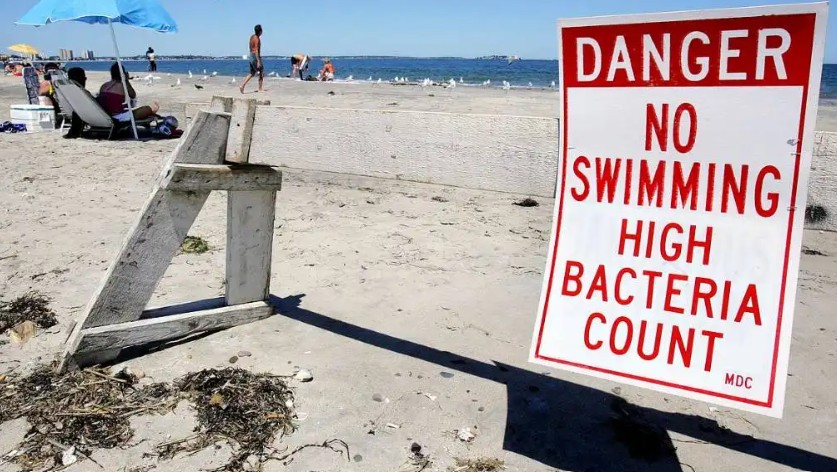
Beachgoers are being warned to stay out of the water at several popular East Coast swimming spots after testing revealed dangerously high levels of bacteria associated with human and animal waste.
Health advisories were issued at beaches across New York City and New Jersey just as millions of Americans prepared to head to the shore for the Fourth of July holiday weekend.
The bacteria detected in the water, known as Enterococcus, is commonly found in the intestines and feces of humans and animals. Although its presence does not necessarily mean sewage is in the water, high levels can indicate possible contamination by disease-causing pathogens.
Officials warned that swimming in contaminated water could lead to diarrhea, vomiting, stomach cramps and other gastrointestinal illnesses. It may also cause skin, eye, ear or wound infections, particularly when polluted water comes into contact with an open cut.
Children, older adults and people with weakened immune systems may face a greater risk of becoming sick.
In New York City, five private beaches across Brooklyn, Queens and the Bronx were placed under advisory after recent testing found bacteria levels above the city’s safety threshold.
The affected locations included Sea Gate 42nd in Brooklyn, Whitestone Boosters Civic Association Beach and Douglaston Manor Beach in Queens, along with Trinity Danish and White Cross Fishing Club in the Bronx.
An advisory means swimming and wading are not recommended, although the beach itself may remain open.
Sea Gate 42nd, a private beach on the western edge of Coney Island, recorded 233 bacteria per 100 milliliters of water — more than twice New York City’s acceptable single-day limit of 104.
At Whitestone Boosters Civic Association Beach, testing found a level of 136 this week. That was a significant improvement from the previous week, when the reading reached a staggering 873 — more than eight times the city’s safety limit.
Douglaston Manor Beach produced an even more alarming result the previous week, with 1,362 bacteria per 100 milliliters of water. That was roughly 13 times higher than the city’s standard, although officials said the level had since fallen substantially.
In the Bronx, bacteria levels at Trinity Danish rose to more than twice the acceptable limit during the previous week.
The nearby White Cross Fishing Club recorded a reading of 127 during the latest round of testing, also placing it above the city’s threshold.
New York City health officials advised people not to swim or wade at any affected beach while an advisory remains in place. Beaches can also be closed completely if authorities discover sewage, wastewater, hazardous contaminants or repeated reports of illness.
Officials cautioned that actual conditions may have changed since samples were taken, especially during periods of extreme heat or following rainfall.
The warnings came as a blistering heat wave gripped the Northeast. Warm weather can create conditions that allow bacteria to survive or multiply, while heavy rain can wash contaminants from streets, yards and storm drains into nearby bays, rivers and beaches.
Experts said elevated bacteria levels may come from several possible sources, including pet and wildlife waste, leaking septic systems, damaged sewer lines and stormwater runoff.
Across the Hudson River, New Jersey officials also issued advisories after four swimming areas exceeded the state’s Enterococcus standard.
The most alarming result was recorded at Cedar Bridge Manor Park in Brick Township, where bacteria levels reached 900 colony-forming units — nearly nine times New Jersey’s safe swimming limit.
Windward Beach, also in Brick, recorded a level of 150 colony-forming units.
Cedar Point in South Toms River produced the same result, while Summit Avenue Beach in Island Heights recorded 110.
New Jersey tests coastal swimming waters for Enterococcus because the bacteria can indicate the possible presence of contamination from human or animal waste.
State environmental officials said the contamination could have originated from animal droppings, leaking sewer or septic systems, or storm drains carrying pollutants into waterways.
Several New Jersey advisories issued earlier in the week were later lifted after additional testing showed that bacteria levels had returned to acceptable limits.
Those locations included Miller Beach in Atlantic Highlands, East Beach in Pine Beach and Anglesea Avenue Beach in Ocean Gate.
The New Jersey beach monitoring dashboard reported no active advisories or closures as of late July 2, indicating that some warnings had already been cleared following new test results.
Authorities urged families to check the latest local water-quality reports before leaving for the beach because advisory conditions can change quickly.
The Environmental Protection Agency recommends avoiding swallowing beach water or placing your head underwater when contamination is suspected. Anyone with an open wound should stay out of polluted water, and beachgoers should wash their hands after playing in the sand.