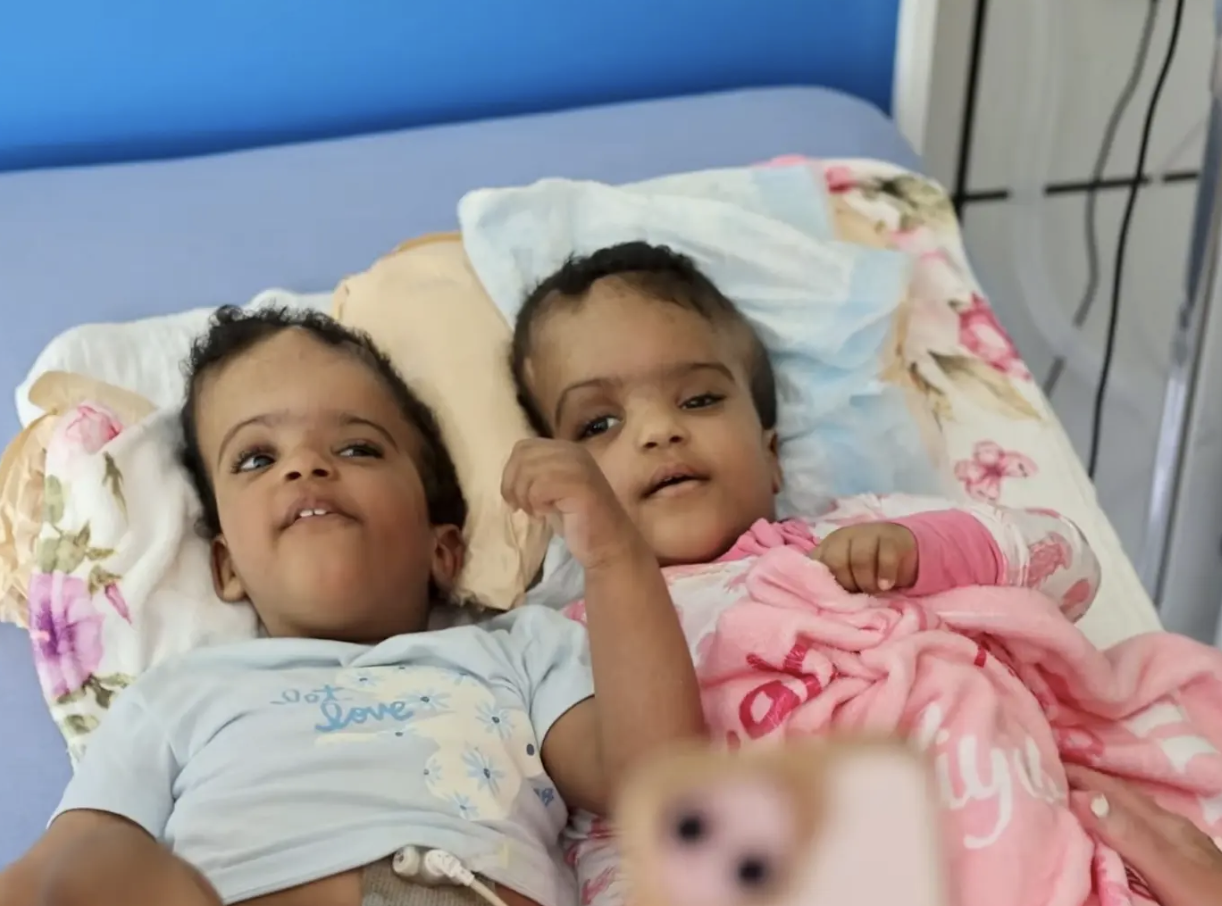
Two little girls born joined at the head are beginning separate lives after doctors in St. Louis pulled off one of the rarest and most complicated operations in pediatric medicine.
Two-year-old Ethiopian twins Hiyab and Wuhbto were successfully separated at SSM Health Cardinal Glennon Children’s Hospital following an operation stretching from February 24 into February 25, the hospital announced this week.
The sisters were born with craniopagus twinning, a rare condition in which twins are joined at the skull.
Their journey to surgery began long before they entered the operating room.
Hiyab and Wuhbto traveled from Ethiopia to St. Louis in March 2025, shortly before their first birthday, so doctors could begin evaluating them and preparing for a possible separation.
Hospital officials said the medical team spent more than 300 hours in planning and strategy meetings before the operation.
More than 30 surgical staff members were involved on the day of the separation, while more than 100 doctors, nurses, therapists and other specialists have participated in the girls’ overall care.
The hospital has also released a detailed timeline showing just how long and carefully coordinated the procedure was.
The twins entered the operating suite at about 8 a.m. on February 24, with the first incision coming about five hours later.
At 2:31 a.m. on February 25, Hiyab and Wuhbto were officially separated.
Closure began around 4:30 a.m., with two teams of four surgeons working simultaneously on the girls. By about 7:30 a.m., the twins were taken from the operating room to the pediatric intensive care unit in two separate beds.
Dr. Andrew J. White, Cardinal Glennon’s chief medical officer, said an operation of this magnitude requires extraordinary coordination among multiple specialties.
“Successful surgical separation of craniopagus twins requires sublime precision,” White said in the hospital’s announcement, adding that every decision was made with the goal of giving the girls the best possible chance to grow and thrive.
The hospital has also published video documenting the twins’ journey and the teams involved in their care. Watch Cardinal Glennon’s official video about Hiyab and Wuhbto. The video is linked directly through the hospital’s official announcement.
Why the surgery is so rare
Craniopagus twins are extraordinarily uncommon.
A recent systematic review published through the National Library of Medicine found that they make up roughly 3.4% of conjoined twin cases. Other medical literature estimates they occur in approximately one out of every 2.5 million live births.
The difficulty is not simply separating two skulls.
Doctors may have to deal with shared veins, blood vessels, brain tissue and protective membranes surrounding the brain. Those shared structures can make blood loss, neurological injury and other complications major concerns during surgery.
A 2026 review of reported craniopagus separation cases found that factors including the twins’ anatomy, whether surgery was staged over multiple procedures, the use of tissue expanders and whether the operation was performed as an emergency were associated with outcomes.
Hiyab and Wuhbto’s operation followed months of preparation that included detailed surgical planning and 3D models. Cardinal Glennon said more than 2,500 feet of filament was used in printing models used during the process.
Their care also became an international effort.
World Pediatrics handled guardianship, consent, family advocacy and international coordination, while Lola Children’s Home had cared for the girls in Ethiopia.
Ronald McDonald House Charities provided lodging and support for their guardian, and Ethiopian Airlines helped arrange the specialized transportation needed to bring the girls to the United States.
Separation was only one step
Although the February operation marked the biggest milestone, the girls’ medical journey did not end once their beds were rolled apart.
Hiyab and Wuhbto continue to receive intensive rehabilitation at Ranken Jordan Pediatric Bridge Hospital in Missouri.
Therapists are now able to work with each girl individually on skills that were difficult or impossible while they were physically joined, including sitting, eventually standing and walking, eating, speaking, playing and interacting with other children.
“They are now able to participate in individually focused therapies,” Dr. Nick Holekamp of Ranken Jordan said, adding that the long-term goal is to help the sisters move toward increasingly independent lives.
Wuhbto has already undergone a successful cranioplasty, a procedure used to reconstruct or repair the skull after surgery.
Hiyab is expected to undergo her own cranioplasty later this fall.
The girls celebrated their second birthday in March — this time no longer physically joined.
For the medical team that spent more than a year preparing for that moment, their progress remains a work in progress rather than the end of the story.
Hospital officials say both girls still face extensive rehabilitation and additional medical care, but their successful separation has given them opportunities that simply were not possible before.