
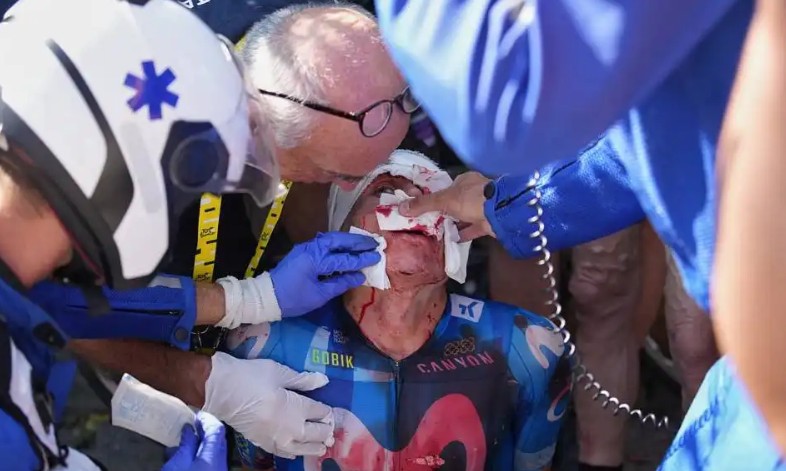
A Tour de France rider was forced to withdraw from the race after a horrifying crash sent him face-first through the rear window of a team car, leaving him with serious facial injuries that required roughly 20 stitches.
Movistar rider Einer Rubio slammed into a UAE Team Emirates-XRG vehicle during Stage 19 as the race climbed the famed Alpe d’Huez.
Video shared on social media showed the Colombian cyclist speeding toward the car before it suddenly stopped to avoid a spectator who had fallen into its path. Rubio had almost no time to react and crashed head-first into the vehicle’s back window, shattering the glass before being thrown onto the pavement.
Stunned spectators watched as Rubio lay bloodied on the road while medical personnel rushed to help him.
The 27th-place rider in the race for the yellow jersey received immediate treatment at the scene before being taken to a medical vehicle. He was later seen with heavy bandages covering his face and was transported by helicopter to a hospital in Grenoble.
Rubio was discharged from the hospital later that night, but his injuries forced him to abandon the Tour.
“Einer Rubio has received around 20 stitches in the face following the accident he suffered during the ascent to Alpe d’Huez,” Movistar said in a statement.
WATCH THE VIDEO BELOW:
UAE Team Emirates-XRG manager Joxean Fernandez, who was driving the car, later issued a public apology while explaining that he had slammed on the brakes to avoid potentially killing the spectator.
“In the final kilometers of the Alpe d’Huez climb, with thousands of fans right next to the road and the immense pressure typical of a decisive Tour stage, a spectator suddenly ran out and fell right beneath our vehicle,” Fernandez wrote on Instagram.
“My only reaction was to brake immediately to avoid running him over. It all happened in a split second, and my only thought was preventing a far worse tragedy.”
Fernandez said those inside the car heard a loud impact behind them, but he did not learn the full extent of Rubio’s injuries until reaching the finish line.
“I deeply regret the consequences of this accident,” he wrote. “If the decisions I made in that moment ended up affecting a rider in the peloton, I can only say that it pains me deeply.”
He also urged fans lining the course to behave responsibly, warning that roadside spectators can create life-threatening conditions for both riders and race vehicles.
Former Tour de France champion Alberto Contador defended Fernandez, saying nearly anyone in the same situation would have reacted similarly.
“Anyone would have reacted the same way—or perhaps a second later, we would be mourning the spectator’s death,” Contador said.
He argued that race organizers should consider fencing off the Alpe d’Huez climb because of the enormous crowds packed along the route.
Rubio’s frightening wreck was not the first dangerous encounter involving spectators during this year’s Tour. One day earlier, Richard Carapaz narrowly avoided hitting a fan who had stepped into the roadway to pose for a photo.
Meanwhile, four-time champion Tadej Pogacar continued his dominant performance by winning the stage and recording what was reported as the fastest ascent of Alpe d’Huez in Tour history. The Slovenian completed the climb in 35 minutes and 26 seconds, reportedly breaking Marco Pantani’s 1995 mark by 1 minute and 14 seconds.
Better the spectator’s death for being an idiot, causing the rider’s injuries.